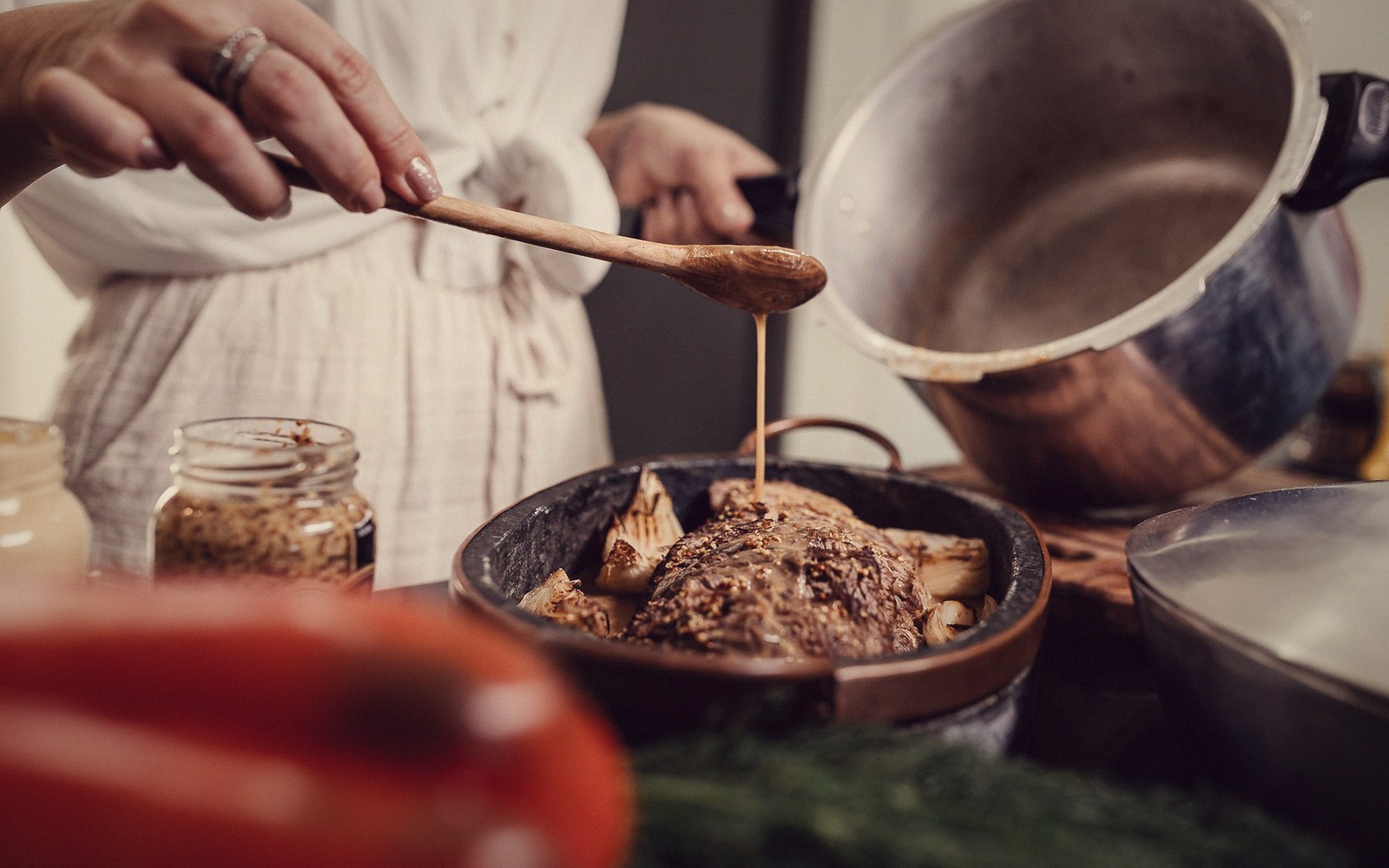
01The Kitchen as a Different Kind of Room
There is a version of cooking that is itself the problem — the frantic Tuesday night scramble, three burners going, a recipe you've never made, half the ingredients missing, and dinner arriving on the table already tasting of stress. And then there is the other kind: a pot on the lowest ring, a glass of water, something bubbling away with no supervision required. These are not the same act. They share a stove and that's about it.
The argument for calm cooking isn't about eating less or eating more simply. It's about recognising that dinner is the hinge of the evening — that what happens in the kitchen for that hour shapes what happens on the sofa or at the table or in bed afterwards. Cook urgently and the urgency tends to follow you. Cook slowly and something starts to land.
This isn't food mysticism. There is real physiology here, modest but consistent: the foods that tend to make an evening feel steadier are, almost without exception, the foods that take time to cook. Braises. Stews. Lentil pots. Long-simmered things where the work is mostly done by heat and patience. The convenience isn't incidental — it's the point.
| The frantic dinner | The slow braise | |
|---|---|---|
| At the stove | Three burners, a recipe you've never made, sizzle deadlines | One pot on the lowest ring, no supervision required |
| Attention it asks for | All of it, right up to the plate | About twenty minutes, then none |
| What follows you to the table | The urgency | The rest of the evening |
02What a Calmer Evening Plate Actually Does
The mechanism worth understanding is blood sugar. Not in the clinical sense, but in the ordinary experiential one: a plate that spikes blood sugar sharply and then drops it tends to produce a corresponding emotional arc — a brief lift, then a flatness, sometimes a low-grade irritability that's hard to name. A plate built around slow-release carbohydrates, protein, and fat tends to flatten that arc, which is why the evening feels steadier rather than deflating.
Legumes are the most reliable thing in this category. Lentils, chickpeas, white beans — all have what nutritionists call a low glycaemic load1, meaning they release glucose gradually rather than all at once. They are also high in fibre and protein, which extends that release and keeps the body feeling settled rather than searching. A bowl of lentils is not glamorous, but it is genuinely stabilising in a way that a bowl of white pasta with not much on it isn't. Beans for the long haul explores that sustained-release quality in more detail; it applies to dinner as fully as it does to lunch.
Protein matters at evening too, for different reasons. The body uses dietary protein to produce neurotransmitters, including serotonin5 — the one most associated with the feeling of things being fine. Serotonin synthesis depends on tryptophan2, an amino acid found in poultry, eggs, dairy, oily fish, nuts, and seeds. The evidence that eating these foods directly and immediately boosts serotonin is not as clean as that sentence might suggest; the process is indirect and the effects modest. But over time, a diet that includes adequate tryptophan-containing protein appears to support steadier mood. An evening that ends with some chicken, some fish, a handful of toasted almonds, is not hurting anything.
Magnesium deserves a mention here too. The mineral is involved in nerve signalling and in the kind of physical relaxation — easing of muscle tension, lowering of the baseline hum — that makes an evening feel like an evening rather than a continuation of the afternoon. Dark leafy greens, nuts, seeds, legumes, and dark chocolate all supply it. A bowl of dal with a handful of spinach stirred in, finished with a square of good chocolate: that's a serious magnesium evening, eaten without effort.
What works against calm is worth naming directly: large quantities of alcohol (which disrupts sleep architecture even if it relaxes initially), very high-sugar desserts, and the kind of heavy, fatty, rapidly consumed meal that sends the digestive system into high-alert mode at the exact moment the body is trying to downshift. None of this means avoiding pleasure — pleasure is the whole point. It means understanding that some foods cooperate with the evening and some work slightly against it.
03The Case for Slow-Cooked Things
A braise is not merely a cooking technique. It is a pace-setter for the whole evening.
Cook urgently and the urgency tends to follow you. Cook slowly and something starts to land.
The practical structure of a braise — twenty minutes of work, then two hours of the oven doing everything — means that the pressure of cooking is finished long before dinner arrives. You can eat a meal you made, without having cooked right up to the edge of it. There is something psychologically distinct about sitting down to food that has been resting for twenty minutes and smelling right for an hour, versus food that arrived on the plate thirty seconds ago from a frantic pan. The body reads the first as abundance and ease. The second reads as emergency rations.
The flavours of slow cooking also do something. Long braising develops depth — the sweetness of caramelised onions, the richness of bone-soft meat or collapsed chickpeas, the thickened, complex sauce that only happens with time. You cannot rush this into being, and that irreducibility is part of its value. It sets a tempo. You cannot eat a braise in three minutes.
A classic example: chicken thighs (cheaper, more forgiving, more flavourful than breasts) braised with canned tomatoes, garlic, a few olives, a splash of wine or stock, and whatever herb is in the fridge. Into the oven at a low temperature. Two hours later: dinner. The effort was maybe twenty minutes. The result is something that took all afternoon. That gap — between the work and the arrival — is the gift.
The same logic applies to a dal. Onions softened in oil with ginger and spices, red lentils added, enough water or stock, then left to cook until collapsed into something thick and golden. Spinach stirred in at the end, a spoon of yogurt on top. This is forty minutes of actual cooking time and perhaps ten minutes of attention. It feeds four people. It is warmth and protein and fibre and magnesium and something that smells like the evening is beginning rather than ending.
Or broth-based things: a big pot of something that is essentially built from whatever's in the vegetable drawer — leeks, carrots, celery, potatoes, whatever legume is open — simmered until unified. Nothing goes wrong with this. There is no critical moment, no technique to master, no timing to get exactly right. You are just watching something become itself.
The practical insight that holds all of this together is the concept of minimal active cooking. The goal is to spend the smallest possible amount of focused attention to produce the largest possible amount of warmth and nourishment. Not because effort is bad but because a calm evening has limited attention to spare, and spending it all in the kitchen leaves none for what follows.
- The first twenty minutesOnions softened, the pot assembled — chicken thighs, tomatoes, garlic, olives, a splash of stock.
- The long middleOven on low. The work is done by heat and patience; you are elsewhere.
- The last stretchThe pot rests, the table gets set, the smell does the advertising.
- DinnerFood that finished cooking long before you sat down to it.
04Sitting Down Is Part of It
A note that feels worth making, briefly and without apology: the food itself is only part of what makes an evening calmer. The conditions in which it's eaten matter too. This is well-established in the research on satiety and pace — people who eat quickly, distracted, consume more and feel less satisfied than people who eat at a table, without screens, at a speed that allows the body to send and receive the signals that communicate fullness and satisfaction.
None of this is moralistic. It's physiological. The parasympathetic nervous system3 — the branch responsible for rest, digest, and recovery — activates fully when the body is at rest, not when it's eating standing up over the sink while checking a phone. A slow dinner eaten at a table is doing something a fast one eaten on the couch is not, regardless of what's on the plate.
The ideal calm evening probably looks like this: something in the oven early. A small appetite-edge taken off with a few nuts or a slice of good bread so the hunger doesn't become urgency. Dinner arriving warm and already rested. Sitting down. No rush.
That's all it is, really. Low heat, long time, a table. Not a recipe for anything specific — more of a method for the evening itself.
Kitchen notes
- glycaemic load — how much a food raises blood sugar, factoring in portion size ↩
- tryptophan — amino acid used by the body to produce serotonin ↩
- parasympathetic nervous system — the body's rest-and-digest mode; active during calm ↩
- braise — slow cooking in a covered pot with liquid, low heat, over a long time ↩
- serotonin — neurotransmitter associated with stable, settled mood ↩
As always, this is general guidance about everyday food and mood, not clinical advice — if you're noticing persistent changes in how you feel, a conversation with a GP or registered dietitian is worth having.