01The Gut-Mood Connection, Without the Hype
There is a version of this story that involves miracle bacteria and transformation in three days, and that version is wrong. The real version is slower, more tentative, and considerably more interesting. What researchers have established over the past two decades or so is that the gut and the brain are in constant, bidirectional conversation — via the vagus nerve, via the immune system, via chemical signals that travel both ways along what scientists now call the gut-brain axis1. The gut lining contains neurons, produces neurotransmitters including a significant proportion of the body's serotonin, and responds to its microbial inhabitants in ways that appear to ripple outward into mood, stress response, and the texture of ordinary days.
The microbiome2 — the vast community of microorganisms living in the digestive tract — is not static. It shifts with what you eat, how you sleep, how much stress you carry. And fermented foods, research suggests, are one of the more reliable ways to nudge it in a useful direction. A study published in Cell in 2021, conducted at Stanford University, found that people who increased their intake of fermented foods over ten weeks showed greater microbiome diversity and lower markers of inflammation compared with those who increased dietary fibre alone. Inflammation matters here because chronically elevated inflammatory markers are associated — not causally proven, but associated — with lower mood, foggier thinking, and a general sense of being depleted.
None of this means a forkful of kimchi will fix a hard week. The science remains genuinely early, the effect sizes in most studies are modest, and the mechanisms are still being worked out. What it does mean is that there's a plausible, evidence-backed reason to care about fermented foods — and that reason is more grounded than most of what you'll read on the subject.
02What to Actually Eat
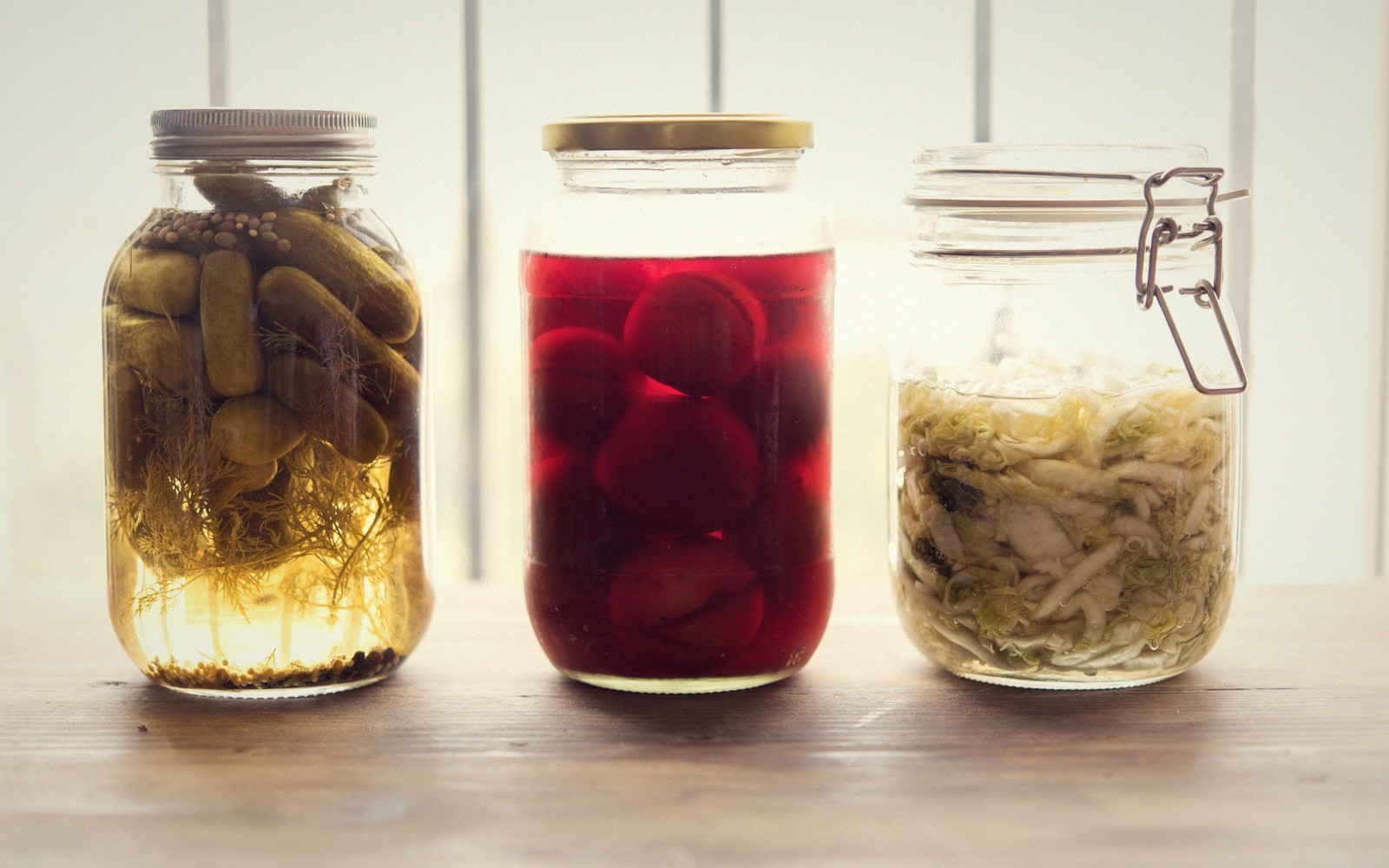
The fermented foods worth knowing about are not exotic or expensive. Sauerkraut — finely shredded cabbage, salt, time — is one of the oldest and most accessible. Kimchi is its Korean counterpart: louder, more complex, built on cabbage or daikon with garlic, ginger, and chilli. Both are live-culture foods when unpasteurised, meaning the bacteria responsible for fermentation are still present when you eat them. Pasteurised versions, which line most supermarket shelves in sealed plastic pouches, have typically been heat-treated, which kills the live cultures3. The jar in the chilled section, with liquid and a slightly funky smell when opened, is what you want.
Kefir5 — a fermented milk drink with origins in the Caucasus region — is easier to incorporate than it sounds. Tart and slightly fizzy, it works as a base for smoothies, poured over oats, or drunk plain. Natural live yoghurt shares some of the same territory, though kefir tends to carry a broader range of bacterial strains. Miso, the fermented soybean paste used in Japanese cooking, brings depth to dressings, broths, and marinades; a small spoonful stirred into warm (not boiling) water with a little seaweed is lunch that actually holds. Tempeh6 — fermented whole soybeans, pressed into a firm cake — is less well known in Western kitchens but worth learning: it has a nutty, slightly mushroomy flavour and takes a marinade beautifully.
The practical rule with all of these is small and consistent over large and occasional. A tablespoon of sauerkraut alongside eggs in the morning, a spoonful of miso in a lunchtime dressing, a small glass of kefir in the afternoon: these are not dramatic interventions. They're habits, and habits compound.
03The Spoonful Next to Almost Everything
Sauerkraut earns a particular mention here because it is genuinely versatile in a way that isn't always obvious. It cuts richness — put it next to roast pork, braised sausages, or anything from a slow oven and it lifts the whole plate. It adds acidity without adding a sauce. It works alongside a slow braise in the same way a squeeze of lemon works alongside fish: not as the thing, but as the thing that makes the thing. Stirred into potato salad in place of some of the dressing. Folded into a grain bowl. Eaten straight from the jar because you're standing at the fridge and it's there.
None of this means a forkful of kimchi will fix a hard week.
The bacterial strains most commonly found in traditionally fermented vegetables — Lactobacillus species, particularly — are among the better-studied in relation to gut health. They survive storage reasonably well in an acidic environment, which is exactly the environment inside a jar of live sauerkraut. Keep it cold, keep it submerged in its brine, and it will last months.
What fermented foods seem to offer, at the level of everyday experience, is less a dramatic shift than a kind of underlying steadiness. Better digestion tends to mean less discomfort, less bloating, and — via pathways the research is still mapping — possibly a slightly more even keel. Not transformation. Not a cure for anything. Just, over time, a quieter baseline from which a day is easier to manage.
That is about as much as the evidence honestly supports. It is also, most days, quite enough.
Kitchen notes
- gut-brain axis — the two-way communication network linking digestive tract and brain ↩
- microbiome — the community of microorganisms living in the digestive tract ↩
- live cultures — bacteria still active in unpasteurised fermented foods ↩
- Lactobacillus — genus of bacteria common in fermented vegetables and dairy
- kefir — tangy, slightly fizzy fermented milk drink containing multiple bacterial strains ↩
- tempeh — firm cake of fermented whole soybeans with a nutty flavour ↩
- inflammation markers — measurable signals of immune activity in the blood
As with all nutrition topics, this is general information rather than personal medical advice. If you're managing a specific gut condition, a dietitian or doctor is the right place to start.